Sustainability is no longer a choice; it’s a necessity for businesses and the planet. As climate change accelerates and resources become increasingly scarce, companies are realising that long-term profitability and environmental responsibility are inextricably linked. This shift goes beyond reducing energy use or cutting emissions; it involves rethinking entire business models to ensure they contribute positively to the environment and society while maintaining profitability.
Importance of Sustainability for the Planet and Businesses
The importance of sustainability for the planet cannot be overstated. Environmental degradation, resource depletion, and global warming are creating a cascade of challenges that affect everyone. Climate change is already leading to extreme weather events, food shortages, and biodiversity loss, and businesses, especially in sectors like logistics, play a significant role in this. According to the International Energy Agency (IEA), transportation alone accounts for more than a third of global CO2 emissions. The logistics industry, with its extensive reliance on transportation and energy consumption, has a direct impact on these figures

For businesses, sustainability isn’t just a matter of corporate social responsibility (CSR); it’s becoming critical to survival. Customers, investors, and regulators are increasingly expecting companies to adopt sustainable practices. According to a 2023 Deloitte survey, consumers have indicated an increasing preference for businesses that prioritise environmental and social sustainability. About a third of consumers stated that their trust in brands would be improved if they were recognised as an ethical/sustainable provider and a third of them also claimed that their trust in brands would be improved if they had a transparent, accountable, and socially and environmentally responsible supply chain. Furthermore, governments are introducing stricter regulations and carbon pricing, meaning that unsustainable practices may soon become economically unviable.
Adopting sustainability practices can provide businesses with a competitive edge. Not only can they reduce operational costs through more efficient energy use and resource management, but they also position themselves as industry leaders and attract eco-conscious consumers.

AI and Sustainability in Logistics Operations
Achieving sustainability while maximising profits requires companies to embrace innovation and integrate sustainable practices across their entire value chain. Artificial intelligence (AI) is one of the most promising tools to achieve this balance. Here’s how AI can help logistics operations become more sustainable, while maintaining profit:
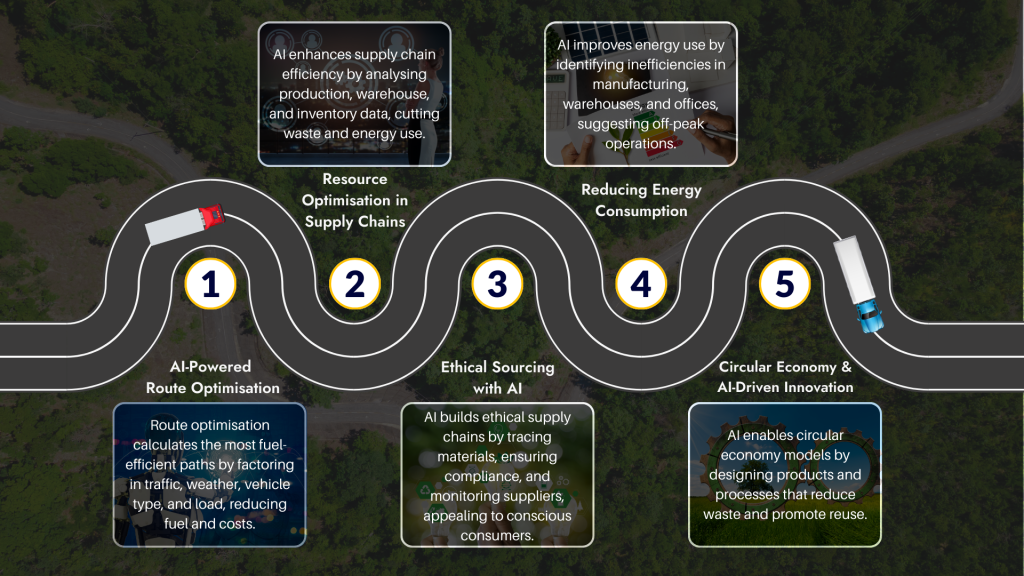
AI-Powered Route Optimisation
Logistics and transportation are some of the largest contributors to a company’s carbon footprint. AI can dramatically improve the sustainability of these operations. For instance, route optimisation algorithms can calculate the most fuel-efficient routes, factoring in traffic, weather conditions, vehicle type, and load. This not only reduces fuel consumption and carbon emissions but also leads to significant cost savings.
Resource Optimisation in Supply Chains
AI can optimise resource utilisation throughout the supply chain by analysing data from production schedules, warehouse operations, and inventory levels. This can lead to reduced waste and energy consumption while improving efficiency. A McKinsey study found that AI-driven supply chain optimisation can reduce forecasting errors by 20-50% and inventory reductions of up to 30%, thereby reducing both costs and environmental impact.
Ethical Sourcing with AI
Ensuring responsible and ethical sourcing of materials is crucial for businesses striving for sustainability. AI can help companies trace the origin of raw materials, verify compliance with environmental and social standards, and even monitor working conditions at supplier facilities. This transparency helps businesses build more resilient, ethical supply chains that appeal to increasingly conscientious consumers and investors.
Reducing Energy Consumption
AI has proven effective in managing energy consumption in manufacturing plants, warehouses, and offices. By analysing energy usage patterns, AI systems can identify inefficiencies and suggest adjustments, such as aligning machine operations with off-peak energy times.
Circular Economy and AI-Driven Innovation
AI can also assist in designing products and processes that minimise waste and promote reuse. By predicting demand and managing resource flows more efficiently, companies can transition from linear “take-make-dispose” models to circular economy models. This not only conserves resources but also opens up new revenue streams, such as through product-as-a-service offerings.
Integrum’s Approach to Sustainable AI Solutions
At Integrum Global, we believe that the key to achieving sustainability lies in using technology and AI to amplify both environmental and economic outcomes. We understand that sustainability metrics should be as integral to AI models as financial metrics are. That’s why our AI-powered solutions are designed not just to improve profitability but to help businesses build resilience by reducing their environmental footprint.
Through a collaborative approach, we help companies integrate sustainability into their core business strategies by leveraging AI’s predictive analytics, optimisation capabilities, and transparency tools. We tailor our solutions to align with the unique sustainability goals and challenges of each business, ensuring that they are not only reducing their environmental impact but also maintaining or enhancing their profitability.
By incorporating AI into sustainability efforts, businesses can achieve a win-win outcome: driving significant environmental progress while also unlocking new efficiencies, savings, and growth opportunities.
Conclusion
In the face of growing climate challenges, businesses that prioritise sustainability will be better positioned for long-term success. Sustainability is no longer just a moral or regulatory obligation but a pathway to innovation, cost reduction, and competitive advantage. AI stands out as a transformative tool that can help businesses strike the right balance between being environmentally responsible and financially successful.
At Integrum Global, we are committed to helping businesses navigate this journey, leveraging AI to foster both economic growth and a sustainable future.