
Artificial intelligence (AI) has rapidly emerged as a transformative force across industries. Yet, the road to successful AI adoption is littered with challenges. While promising prototypes often create initial excitement, many organisations find themselves floundering when it comes to scaling their AI initiatives. Gartner, Inc. has estimated that 85% of AI projects have failed to produce a return for the business. In this article, we’ll examine the key obstacles in AI adoption and why the gap between prototyping success and scaled implementation can be so vast.
Challenge 1: The Data Dilemma
AI systems are inherently data-dependent, with the quality, quantity, and accessibility of data crucially influencing their success. In the prototyping phase, data is carefully chosen and prepared to ensure models or algorithms operate effectively, relying on curated datasets that are clean, well-organised, and reflective of expected scenarios. This allows for efficient model training, free from the unpredictability of real-world data. However, transitioning to real-world applications introduces challenges; data becomes messy, inconsistent, and often biased due to its varied sources and lack of adherence to prototyping standards. These issues with data quality can introduce algorithm bias, produce skewed results, and compromise reliability, posing significant obstacles to scalability.
Challenge 2: The Talent Gap
Building, deploying, and maintaining AI systems requires specialised expertise. The demand for data scientists, machine learning engineers, and AI experts far outstrips the current supply, creating a talent bottleneck. Organisations often lack the in-house capabilities to effectively manage the complexities of AI development and may become heavily reliant on external consultants, which can be costly and create knowledge gaps when those partnerships end.

Challenge 3: Integration Woes
Operationalising AI into existing business systems and workflows can be a daunting task. Legacy systems may not be compatible with sophisticated AI algorithms, requiring extensive modifications or expensive overhauls. This lack of seamless integration can create friction, increase operational costs, and ultimately impede the scaling of AI solutions.
Challenge 4: Cost Considerations
AI adoption carries significant costs. Investments in hardware, software, talent acquisition, and continuous maintenance can quickly add up. Small-scale prototypes may not reveal the true cost implications of a scaled AI deployment. As projects expand, the financial burden can become substantial, especially for organisations with limited resources or uncertain ROI projections.
Challenge 5: Ethical and Regulatory Uncertainty
AI raises a host of ethical concerns around biasness, transparency, and accountability. The regulatory landscape for AI is still evolving, with different jurisdictions adopting varying approaches. This lack of clarity and harmonisation can hinder AI adoption, particularly in industries where compliance is paramount, such as healthcare or finance. Organisations need to grapple with the ethical implications of their AI solutions to avoid potential backlash or reputational damage.

Why Prototyping Succeeds
Prototypes exist in a focused environment. Limited datasets, set objectives, and well-defined parameters can contribute to their apparent success. Prototypes serve the essential purpose of demonstrating the potential of AI technology, securing buy-in from stakeholders, and identifying potential roadblocks early on. However, they often oversimplify the complexities of real-world deployment.
The Scaling Conundrum
The shift from prototype to scalable AI implementation unveils hidden challenges:
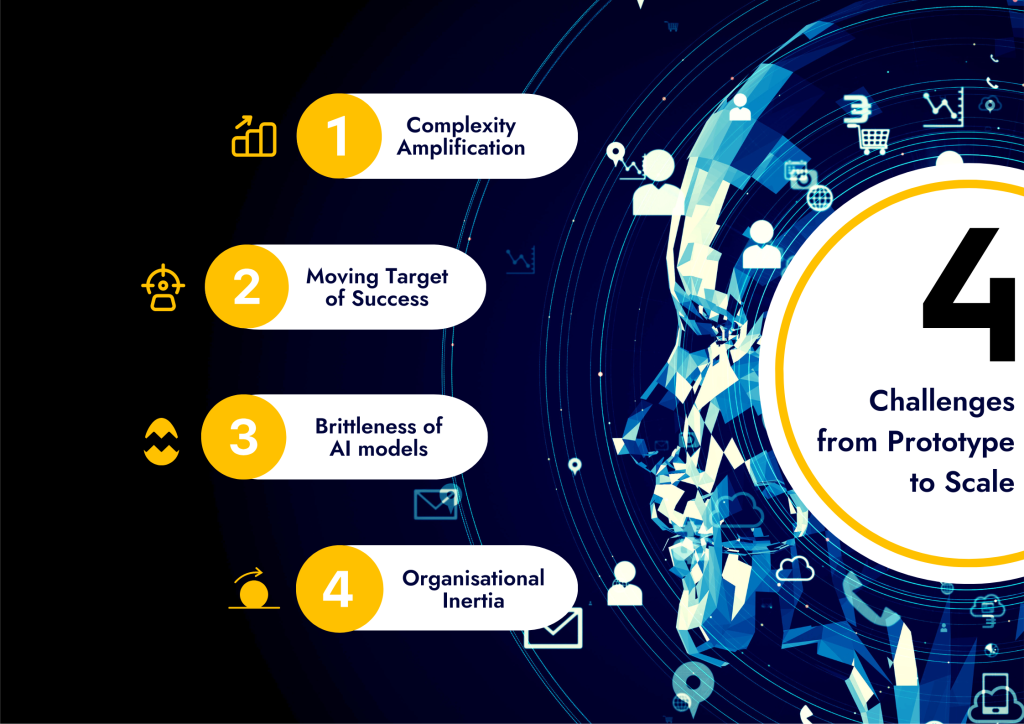
- Complexity Amplification: As AI projects expand in scope, complexity increases exponentially. Larger datasets, diverse data sources, and the need for real-time processing place immense strain on systems and processes.
- The Moving Target of Success: Goals that seemed well-defined during prototyping may become less clear when scaling. Metrics for success need to evolve and adapt to the changing needs and real-world constraints.
- The Brittleness of AI Models: AI models trained on curated prototype data may not generalise well to the messy, unpredictable nature of real-world situations. This brittleness can lead to performance degradation and unexpected failures.
- Organisational Inertia: Scaling AI often requires transformation across an organisation. Resistance to change, lack of cross-departmental collaboration, and inadequate training can stifle momentum and derail scaling efforts.
Operationalising AI: The Bridge from Prototype to Full Capability
The successful transition from promising AI prototype to impactful operational reality hinges on a robust operationalisation framework. Our full framework guides the process of understanding, experimenting, developing, testing, deploying, and integrating AI solutions into an organisation’s core operations. Here is part of the full framework that bridges the gap:
- Experimentation Phase: This phase rigorously tests the AI model in real-world environments. The goal is to uncover performance issues, identify potential biases, and ensure the model functions effectively in its intended use case. Operational testing is crucial to mitigate risks and refine the model before wider deployment.
- Adoption Phase: The adoption stage involves a focused deployment targeting a specific problem with well-defined success metrics. This creates a smaller-scale, controlled environment to gather valuable data on the model’s performance and user adoption. The learnings from this phase can be used to refine the AI solution, build trust within the organisation, and secure further investment for scaling.
- Expansion Phase: Once the effectiveness of the AI solution is proven during the adoption phase, it’s time to scale and integrate it with core business processes. This expansion phase requires careful planning and execution. Addressing compatibility issues, ensuring seamless data flows, and implementing robust monitoring systems are paramount for creating a truly integrated AI-enabled operation. At this phase, the AI system becomes a fundamental element of the organisation’s workflow, driving process improvements and delivering significant business value.
The Operationalisation Framework in Action
An operationalisation framework provides a structured approach to navigate the complexities of AI scaling. By incorporating the experimentation, adoption and expansion phases, organisations can:
- Reduce Risks: Rigorous testing helps identify issues early, minimising the potential for disruptive failures later.
- Build Confidence: Successful adoption deployments demonstrate the value proposition of AI and build trust among stakeholders.
- Facilitate Iterative Improvement: Learning from adoption informs improvements to the AI model and its integration processes, leading to a more effective expansion deployment.
- Optimise Performance: The operationalisation framework ensures seamless integration and data flows, fostering optimal performance of the AI system at scale.
Conclusion
AI holds immense promise but traversing the path from idea to value creation is complex. Understanding the pitfalls of AI adoption and embracing a strategic, long-term approach and operationalisation framework is crucial for success. While prototypes play a vital role in igniting AI exploration, it’s the organisations that master the scaling hurdles that will reap the true benefits of this transformative technology.
At Integrum Global, our commitment lies in empowering teams with the skills needed for mastery in the ever-evolving, AI-driven landscape. Through joint, creative processes, we work closely with our partners, clients and organisations to co-create and innovate solutions tailored to the unique challenges encountered on the path to AI adoption.
Stay tuned for further discussions on other parts of our AI operationalisation framework.